
“We love the design concept, but what will it cost to build?”
Cost estimating has always been a critical component in the planning process for senior living projects, which in the not-for-profit world have often involved bond financing. In today’s economy it is that much more important to answer this question early. But at the same time it’s increasingly challenging due to market volatility, worker shortages and lingering supply chain issues.
So how can you budget, and ultimately control costs, for your next senior living project? It starts with understanding a few fundamentals.
What Goes into a Cost Projection?
A senior living project cost projection considers project scope, project size, grossing factor, hard and soft costs, contingency and escalation. Cost per square foot alone does not account for all of these factors.
There are a myriad of factors that must be taken into account:
Project Scope
Project scope is the foundational program menu of spaces, functions, capacity and sizes. It’s when goals and aspirations are merged with quantitative requirements.
Project Size
Project size is calculated in terms of gross and net square footage.
- Gross floor area includes everything within a building’s exterior walls.
- Net floor area is the usable square footage excluding walls, columns, lobbies, corridors, stairways, elevators, closets and utility chases.
Grossing Factor
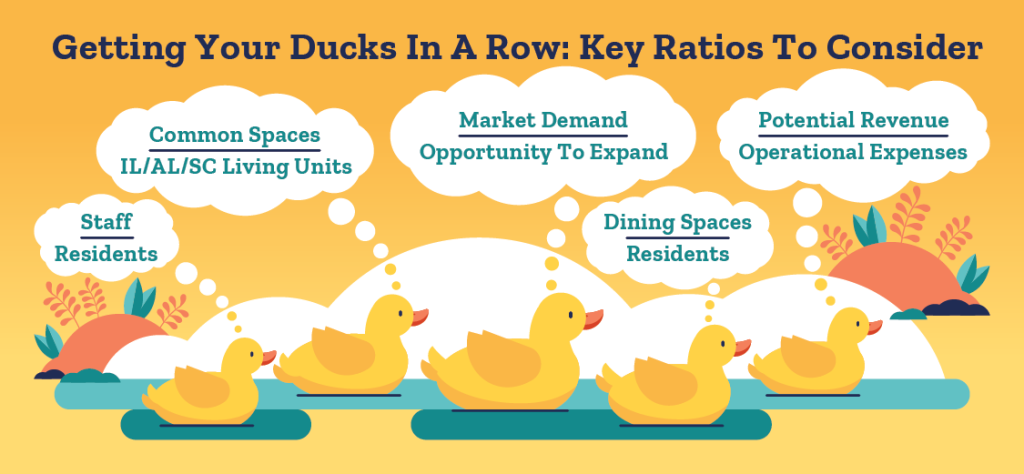
Grossing factor refers to the ratio of revenue generating (living units) to common areas, utilities and wall spaces. It is impacted by building shape and program components.
- A straightforward linear building typically has a lower grossing factor than a structure with bends or curves.
- Smaller building types have a higher grossing factor than a larger building with more living units, such as a hybrid home versus a larger apartment building or a small house versus a larger care setting.
- Social spaces on each floor of an apartment building increase the grossing factor. For senior care settings, a medical model typically has a lower grossing factor than a household model which tends to have more common spaces.
Hard Costs
Hard costs are also referred to as brick-and-mortar costs. These are the construction labor and material costs associated with the building and construction site.
Over the course of many years, we’ve observed a number of factors that impact senior living project costs. The obvious ones are commodity pricing and labor shortages,” shares Larry Graeve, Senior Vice President for The Weitz Company.
He also cautions owners not to be lured by an unrealistically low construction number during the Concept/RFP stage.
We all want to believe that low ‛marketing’ number, but too often it just sets false expectations. Make sure you hire a reputable Construction Manager/General Contractor that understands senior living and knows how to price the project correctly at the onset,” Graeve recommends.
Soft Costs
Soft costs are the intangibles such as professional services fees and permitting costs. Examples include site survey, legal costs, financing costs, development fees, utility tap-in fees or furniture, fixtures and equipment (FF&E).
Contingency
Contingency is a project cost percentage reserved to cover unanticipated construction costs or delays. Common examples are added excavation costs for bedrock removal or an extended entitlement process, particularly in urban areas.
Escalation
Escalation refers to anticipated rise in labor and material costs in subsequent years. This percentage increase allocation is included for design phase estimates or for multi-phased construction budgets.
What Factors Drive Senior Living Project Costs?
The short answer to what drives project cost is everything! Major factors include the building program, site and existing conditions, financing, construction duration, deferred maintenance and the timing of bringing a project to market.
Your financial advisor and/or development consultant can assist with dashboards that calculate critical factors including the cost to operate a new or repurposed building following construction completion. However, there are a few key project development parameters that have significant impact.
Program
“Scope creep” is a very real contributor to project costs. The building program is vetted and developed as the basis of the project budget and design.
I often see a big jump in the construction schedule duration and probable cost when we move from the schematic design to the design development stage,” shares Craig Witz, Principal of Witz Company. “So it is important to track all project metrics (net square feet, gross square feet, all construction line items, schedule assumptions, etc.) and overall cost projections at every step of the process.”
There is a delicate balance between adhering to this program and a mindset that “this is our chance to get everything we want.” It is critical to define wants versus needs. Adjusting the program by a few square feet “here and there” seems negligible, but these incremental increases can add up quickly.
Too often the initial program does not reflect market needs and square footage is added to fill the missing element,” Graeve says. “Scope creep also occurs when the grossing factors are insufficient for the intended design. Recognizing the variables impacting the grossing factors early in process helps the team set the right grossing factor and avoid unwanted square footage creep down the road.”
 New Construction
New construction involves more land development expense, as well as costs related to entitlements, pre-sales, financing and or fundraising. Site costs must be defined and accounted for in project budgets. Expect more expansive—and expensive—development for sites with significant constraints, such as underlying bedrock or hilly properties with significant grade variation. The distance to tie into existing utility infrastructure is another major cost factor. Urban sites often incur additional costs, whether new construction or renovation, due to logistical issues with tight sites in a heavily populated and trafficked setting.
Renovation
Cost savings from retention and reuse of the shell, foundation and structure can represent up to 20% of the building value for a major renovation project. However, these savings are often offset by additional construction time needed for phasing, occupant relocations and demolition/removal tasks. Existing conditions and design constraints of a renovation can limit amenities and features that may be desired by future consumers. Community sponsors must ask the tough questions to determine if renovation savings compensate for future marketability or if it would be better and more cost-effective in the long run to build new.
And it’s important to consider the likelihood of potential hidden conditions that add cost to a project such as hazardous materials mediation. Design teams strive to work around cost-prohibitive elements such as structural
load bearing/shear walls or underground utility points.
Financing Plan
A financing plan is another important component of project cost.
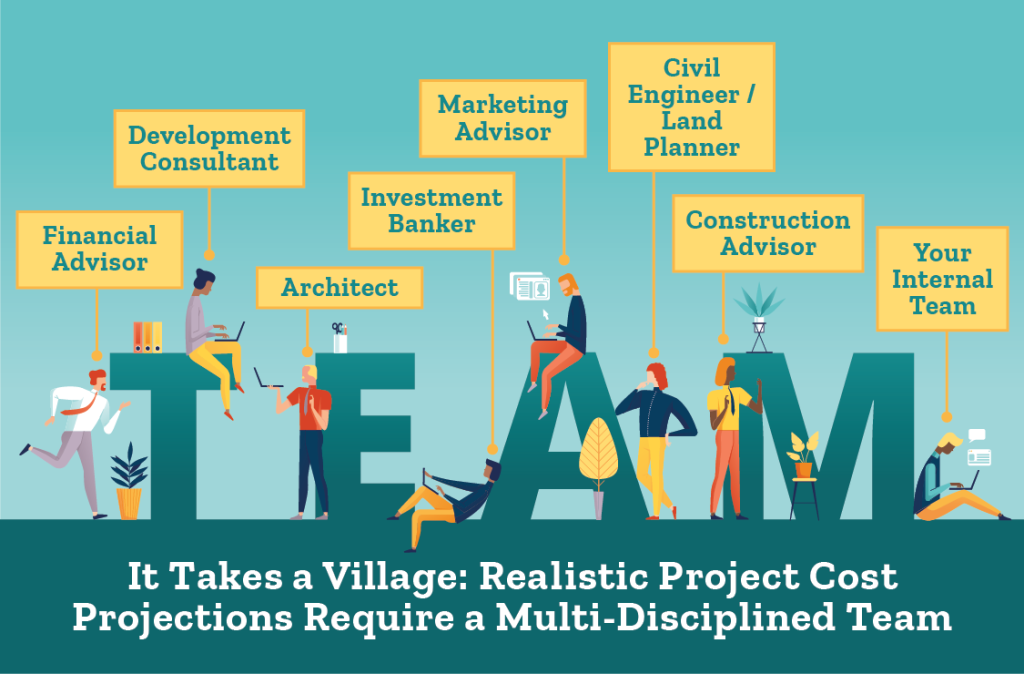
All-in project cost and ultimate feasibility is meaningfully impacted by the plan of finance, including financing structure and total financing requirements, such as funded interest/reserves and financing cost,” points out James Bodine, Executive Vice President at HJ Sims. “There’s real value to early engagement of investment banking professionals as part of the project planning team and process.”
Cost of Construction Duration
Cost of construction duration refers to a correlating cost increase for every month or year that construction is extended. Quite simply, a shorter construction schedule equals a lower cost. Phasing is often unavoidable due to financing constraints or occupancy requirements. But a longer construction period means higher costs. This is the result of paying for general conditions, the items and resources needed at the construction site, that much longer, as well as inflation over the construction period. Examples of general conditions include trash removal, temporary offices, utilities and short-term safety measures like barriers and warning signs. General contractor labor for on-site supervision/oversight of the project is also part of general conditions. In addition, material and labor escalations are a given. There is no question that construction will cause some level of disruption to daily life on campus. But asking residents and staff members to live with more construction disruption for a shorter overall construction duration equates to cost savings.
Deferred Maintenance
Deferred maintenance is increasingly part of the equation for project costs. The practice of postponing maintenance activities is widespread, despite research indicating that delaying maintenance can increase future costs and capital expenditures by as much as 600%. However, uninformed capital projects can lead to redundant costs. For example, replacing an emergency generator near the end of its useful life seems obvious. But a strategic master plan provides a wider lens for holistic decision-making. If new construction is planned, the replacement generators may need to be upsized to handle higher electrical demands. In that case, it would be more cost effective to defer maintenance until plans are in place.
How Can We Control Project Cost?
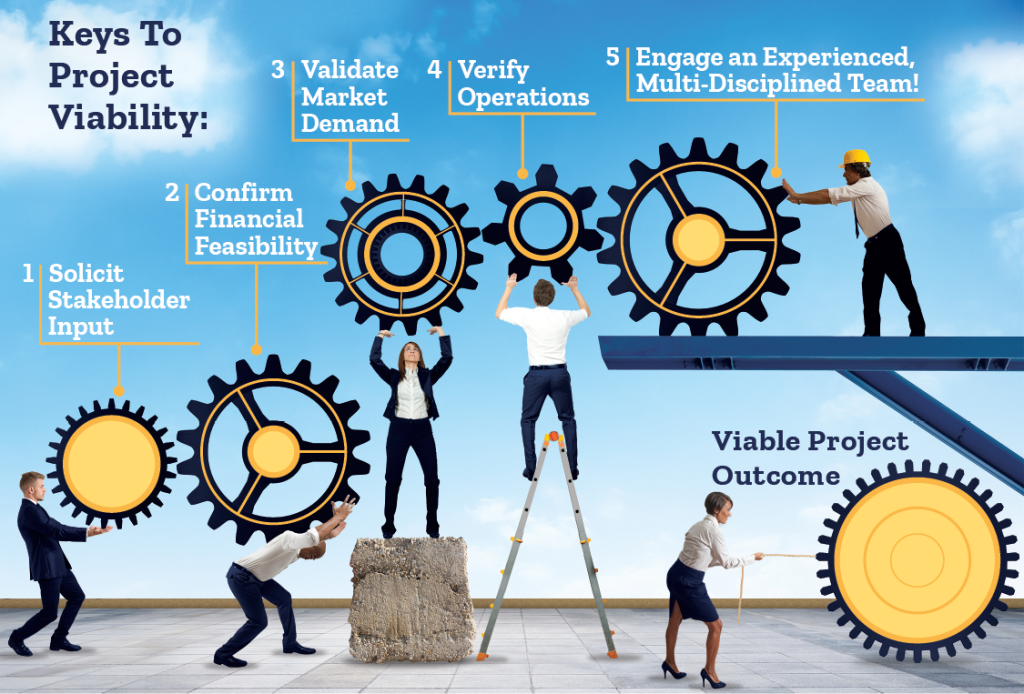
Understanding all program aspects and cost drivers not only enables the design team to plan accordingly, but also helps to make the owner’s vision a reality. Projects involving multiple professional disciplines from the start are more likely to result in a financially executable project plan.
Avoiding “Design-by-Committee”!
For timely decision-making and fending off project scope creep. These goals are almost impossible to achieve “by committee.” Focus groups give voice to a broader group of constituents to maintain momentum and avoid sidetracking the design process. The Project Development team must be strategic.
Efficient Decision-Making
Although supply chain issues have alleviated somewhat, delays and substitutions are still frequent occurrences. Having an authorized point person who can make timely decisions will help to minimize significant material delays and resulting cost escalation.
Forward thinking pre-purchasing and early onboarding for subcontractors can represent significant cost savings. Your design team needs to be aware of the need to move through the submittal process earlier in the construction process to lock in pricing and minimize cost increases. This makes the submittal schedule from the contractor even more important to produce as early as possible so planning of resources can align with project needs.
Cooperative Team Relationship
Cooperative team relationship equals better decision-making. An open, collaborative and cooperative team dynamic will help to keep a project on track from perspectives of schedule, cost and design intent. When decisions are made unilaterally, key details can be missed, which can add to costs later in the process.
Involving Construction and Financial Professionals in Early Planning
Involving construction and financial professionals in early planning provides a sense of team ownership in all decisions. It will also facilitate timely pricing updates for informed decision-making and provides early input regarding constructability strategies.
It is key to get a construction professional involved early in the process so they can give you real-time input as the proforma evolves,” according to Witz. “With the current fluctuations in construction prices, some of the traditional square-foot cost resources are just not useful in today’s market.”
Having an experienced construction manager or advisor who knows the market will help the team anticipate impacts of any labor shortages, material cost increases or other potential escalators. Likewise, involving your investment banker early in the process provides crucial insights for determining overall project costs.
Borrowing costs are an important input into the overall cost and the affordability of a project. Finance professionals will not only provide advice about interest rate assumptions but also on the financial structuring possibilities that may make a project more affordable,” states Amy Castleberry, Manager Director at Ziegler. “It is important to provide enough of a cushion in borrowing costs to allow for market fluctuations during the planning process,” Castleberry adds. “However, interest rate assumptions shouldn’t be unreasonably high, placing too high of a hurdle on project planning.”
Having a Solid Building Program
Defining and getting buy-in from all stakeholders for the program and corresponding space needs as early as possible helps to avoid costly changes later in the project. A financial advisor and/or development consultant can help owners “run the numbers” for operating cost constraints that will drive program viability. For example, if considering a new wellness center or dining venue, you will need to define the operational cost to your organization. Can you afford a new space that will require four Full Time Employees (FTEs) or will your operating budget support only two FTEs? The building program must reflect those operational cost realities.
Phasing Flexibility
Phasing flexibility is being able to place more or less project scope into a given phase when final construction pricing is provided can have positive cost impacts. An effective project management plan incorporates those “levers.” This provides the flexibility so you can do more now due to better pricing or deferring some of the work until later if pricing comes in high.
Speed to Market
Speed to market is a frequently underestimated cost driver that has a big impact. The entire project team (including sponsors) must have an understanding of the established project schedule and the cost impact for not meeting that schedule. The clock starts the moment a sponsor begins investing in the planning exercise, not at the construction start.
This cost is determined by the lost revenue for each month a product is not brought to market. Once the project development cost meter starts to run, all team members must strive to streamline the decision-making process to achieve project goals and reach completion as efficiently as possible.
Hybrid apartment buildings are an example of a housing model that can reach the market more quickly by virtue of having smaller numbers of apartments in individual buildings. Construction of each building can start in conjunction with marketing. Marketing quotas for a 60-unit apartment building will take four times as long as meeting those quotas for a 15-unit hybrid building. The speed at which the reduced quota is met allows construction to start sooner and occupancy to be achieved more quickly as well. Speed to market in this scenario will save the owner on construction interest fees.
What’s the Cost of Doing Nothing?
Everyone is concerned about project costs. On top of that, community sponsors are dealing with staffing shortages and declining reimbursements. It can be easy to put off plans for future updates or growth while focusing on these day-to-day challenges. However, industry pressures and competition are not going away.
Plus, there are some indications that things are moving in a positive direction.
We’ve experienced two years of double-digit inflation, subcontractor backlogs remain strong and the labor shortage continues,” Graeve states. “However, we are now beginning to see a softening in the market. Relief is in sight as residential and commercial sectors pull back due to the higher interest rates. We are also seeing lower commodity pricing on lumber and steel. Going forward we anticipate the inflation rate to be closer to 1/2% to 3/4% per month over the next 12 months.”
Marketing efforts, staff recruiting and retention, as well your organization’s reputation in the community are all negatively impacted when campuses start to feel “tired” and outdated or don’t have the right mix of housing to cover operational costs. Much like deferred maintenance, the longer it goes, the more these effects are compounded. Failure to anticipate, prepare and build for the future makes it harder to regain ground in the future. Or, as Benjamin Franklin put it, “By failing to plan, you are preparing to fail”.
Considering a Senior Living Project?
We’d love to discuss your objectives and help you determine a viable solution.
Acknowledgements
James Bodine, HJ Sims; Amy Castleberry, Ziegler; Larry Graeve, The Weitz Company; Craig Witz, Witz Company