As college and universities work to survive a trend of declining enrollment, many are facing the reality of housing that doesn’t meet the demands of today’s students. Based on data from the national student Clearinghouse Research Center, undergraduate enrollment has increased slightly but remains below pre-pandemic levels.
Today, many campus residence halls in use were built for the “boomer” generation of the 1950s and 60s. Facility design at that time took a practical approach and accommodated the large number of students pursuing higher education. The buildings, featuring concrete or steel frames, maximized space and provided basic amenities.
While many of these buildings remain physically sound, their systems, finishes and furnishings are at the end of their life cycle. Newer housing constructed during the 70s, 80s and 90s also needs to be updated to current standards for aesthetics, technology and operational efficiency.
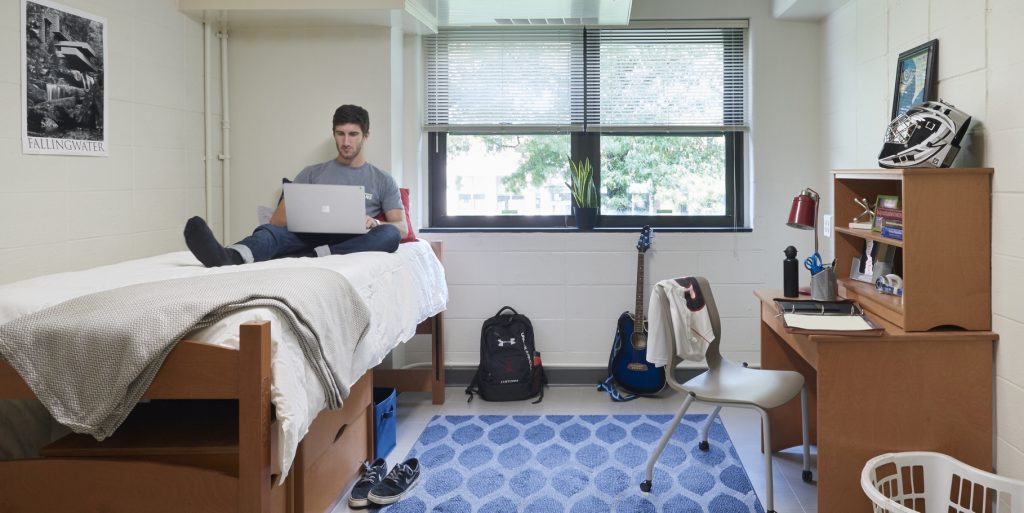
1) Meet Student Expectations
Campus housing is a valuable marketing tool to attract students and keep them living on campus. In recent studies, 67% of students consider housing options and factor this into their decision when making their choice of where to continue their education. To help attract and retain students, older residence halls on campus need to be updated more than just a fresh coat of paint before the fall semester begins. Technology, wellness, accessibility and flexibility are just a few of the elements to keep in mind when planning projects.
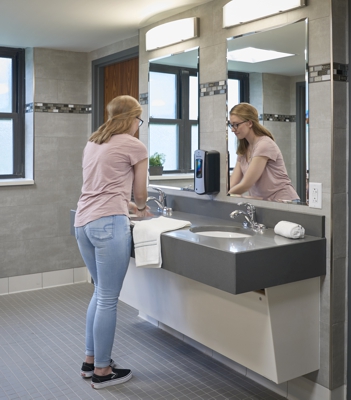 Addressing the Need for More Privacy
Bathroom renovations are often the focus of student housing updates. Students no longer want communal bathrooms. They expect privacy and accessibility similar to what they have at home. These expectations are frequent drivers for facility renovations.
Updating residence halls to all-gender bathrooms, adapting communal bathrooms for more privacy and reconfiguring room layout to provide private bathrooms are ways to meet student demand. For example, hard-walled toilet rooms or redesigned toilet stalls with floor-to-ceiling partitions and gap-free doors enhance privacy in communal bathrooms.
Adding and Enhancing Amenities
Most older residence halls also lack the amenities that appeal to today’s students who expect accommodations for learning to occur anywhere and everywhere. Contemporary student housing blurs the lines between academic spaces and residences to promote individual and group learning beyond the classroom.
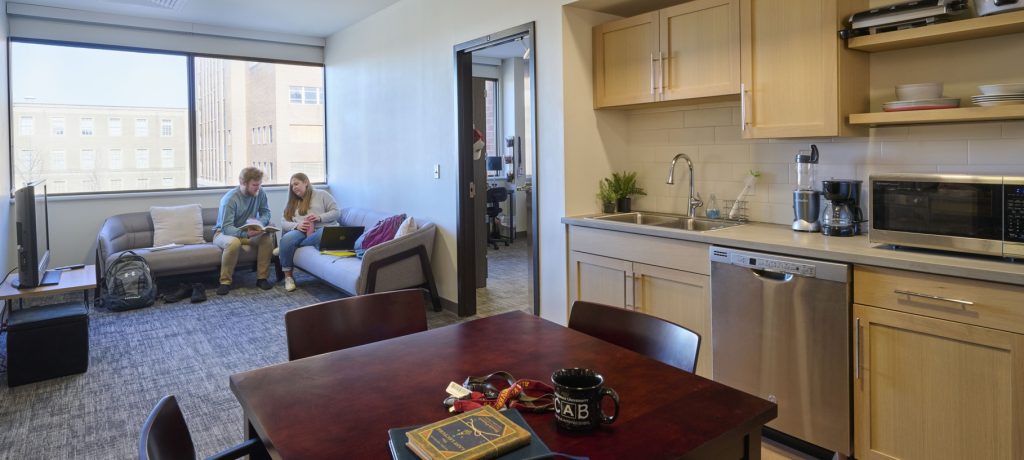
Introducing new interior finishes and flexible furnishings and reconfiguring the layout makes older buildings attractive to prospective students. Providing a mix of spaces throughout a building also helps to create a unique identity. Renovations can substitute a combination of quiet study and group interaction spaces that include:
- Dedicated common areas with distinct purposes (quiet study, social gathering, group project work)
- Outdoor spaces with seating, Wi-Fi access and charging stations
- Shared kitchens and dining areas that encourage social interaction
2) Save Time and Money
New construction avoids the constraints of having to work within a building’s infrastructure, but updates to existing student housing can offer cost and scheduling efficiencies. This is notable since many private and public institutions are facing constricted budgets due to the impacts of financial and enrollment challenges.
By retaining and reusing the building shell, foundation and structure, a savings of upwards of 20% can be realized. Likewise, renovations often shorten project timelines by avoiding the land development process and eliminating or significantly reducing site preparation time.
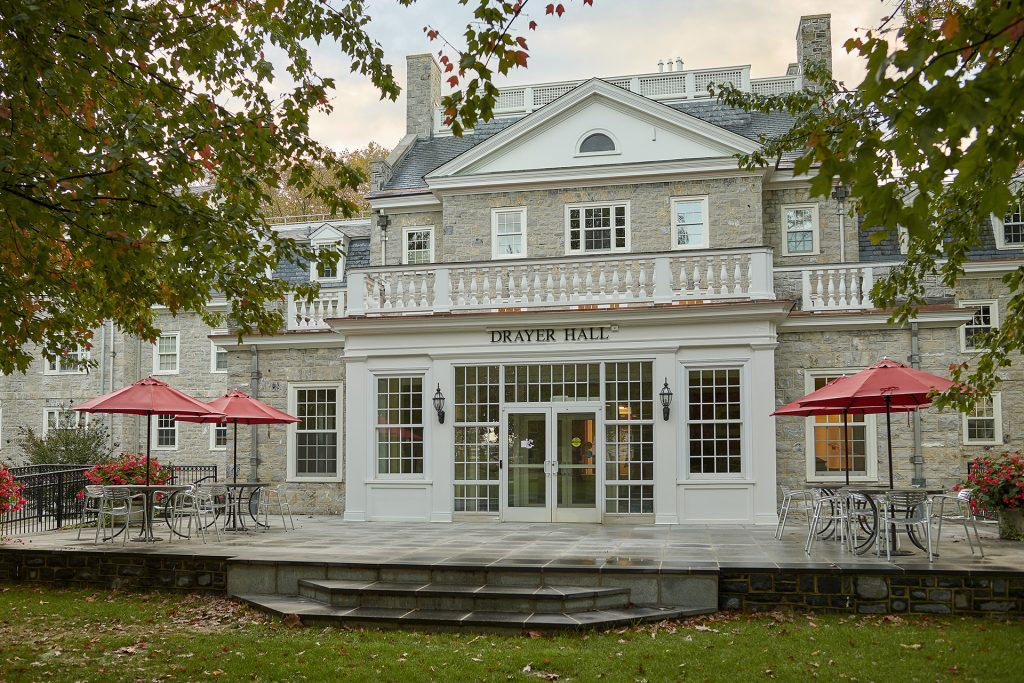
More often than not, older housing is located in a prime location at or near the campus center, making replacement more challenging, costly and disruptive to campus life. Student housing updates eliminate the need for additional land development and can help to preserve your campus character and culture – particularly when it comes to historical buildings.
3) Enhance Sustainability / Improve Operational Efficiency
Campus updates help convert older housing into a valuable asset for attracting and retaining students while also supporting an institution’s sustainability efforts. Updating existing housing (and other buildings) to serve a campus for years to come is one of the most environmentally responsible measures a college or university can take. Renovations also allow institutions to update building systems to enhance sustainability and reduce operating costs.
Choosing to make student housing updates on existing buildings sends less waste to landfills, reduces the amount of resources used and reduces carbon emissions; this demonstrates an institution’s commitment to sustainable practices. Adding insulation, new windows and energy efficient systems can reduce energy consumption while enhancing student comfort. New plumbing fixtures offer reduced potable water usage. Updated lighting enhances living spaces. When coupled with power system upgrades, lighting updates also positively impact energy consumption.
Adding insulation, new windows, and energy-efficient systems can significantly reduce future energy consumption, as well as enhance student comfort. New plumbing fixtures offer a significant reduction in potable water usage. Updated lighting enhances living spaces. When coupled with power system upgrades, these updates also deliver a positive impact on energy consumption.
Living on campus is a cornerstone of university life and contributes to the collegiate experience. Whether the goal is to refresh dated interiors, provide new amenities, or upgrade building operations, enhancing the student living experience on campus provides benefits to students and the institution.
There is no one-size-fits-all approach to campus renovations but both small and large projects benefit by completing a feasibility study before initiating updates. A feasibility study evaluates existing building conditions in the context of project goals and objectives. Realistically assessing a building’s potential is essential to understanding what can be achieved, likely challenges, work timeframes and associated costs.
Our team collaborates with your staff to develop strategies that align available funding with desired outcomes, stakeholder engagement and the potential for summer construction periods. This applies to student housing updates, significant building reconfiguration, small-scale and deferred maintenance projects, as well as building integrity-focused projects such as building envelope details, roof repairs and window replacement.