Design for People Living with Dementia
The way people living with dementia are treated, perceived, and engaged (or not engaged) can impact quality of life almost as much as the cognitive changes they are experiencing. The built environment plays a key role and must be carefully designed to function as a silent partner in helping people live well.
The senior living sector has slowly but steadily migrated away from the traditional medical model. Alternate approaches to memory support design include the small house concept, household model, integrated living, and still others that continue to evolve.
The built environment is an important piece of the puzzle for helping people with dementia live well,” says Dustin Julius, Partner at RLPS. “Even the most dedicated staff and innovative program approaches are more successful when the physical spaces align with what they are trying to achieve.”
While the initial foundation of these newer care models was enhanced quality of life, next generation models are reaching beyond this to provide autonomy, freedom of choice, and authentic experiences.
Within each of these memory support models, there are common goals. For instance, many people living with dementia struggle with spatial literacy: “Where am I, how do I get where I want to go, and what can I expect others to be doing there when I arrive?” We must create navigation tools by embedding cues within the environment.
Model Paradigms
The Neighborhood Model
Past care facilities had long, indistinguishable corridors of resident rooms which often intersected at a large, central nurses station overlooking an undefined common area. Wayfinding was difficult not only for residents, but families, visitors and staff alike—much like a typical hospital experience. The neighborhood model breaks down the physical scale of these former behemoths.
Smaller groups of resident rooms are organized around dedicated common and support spaces. This model is designed to share common living, dining, and activity spaces with other neighborhoods. Wayfinding can be enhanced by giving each neighborhood its own identity through the use of unique color palettes, artwork, furnishings, and accessories. Some communities further reinforce identity through staff uniform color coordination.
The Household Model
This approach takes the scale reduction concept one step further with smaller resident social activity and dining spaces. Each household functions as a self-contained residence with its own internal front door, but is connected to central staff and support spaces. Most meals are prepared in a central production kitchen for finishing and serving in the household.
Whether a new building or renovation, the core concept of these models places resident experience at the center. By designing a home-like scale, spaces are familiar and can be more easily interpreted by people living with dementia. This familiarity and ‘readability’ achieves spatial literacy, where wayfinding is simplified, and autonomy and freedom of choice are encouraged.
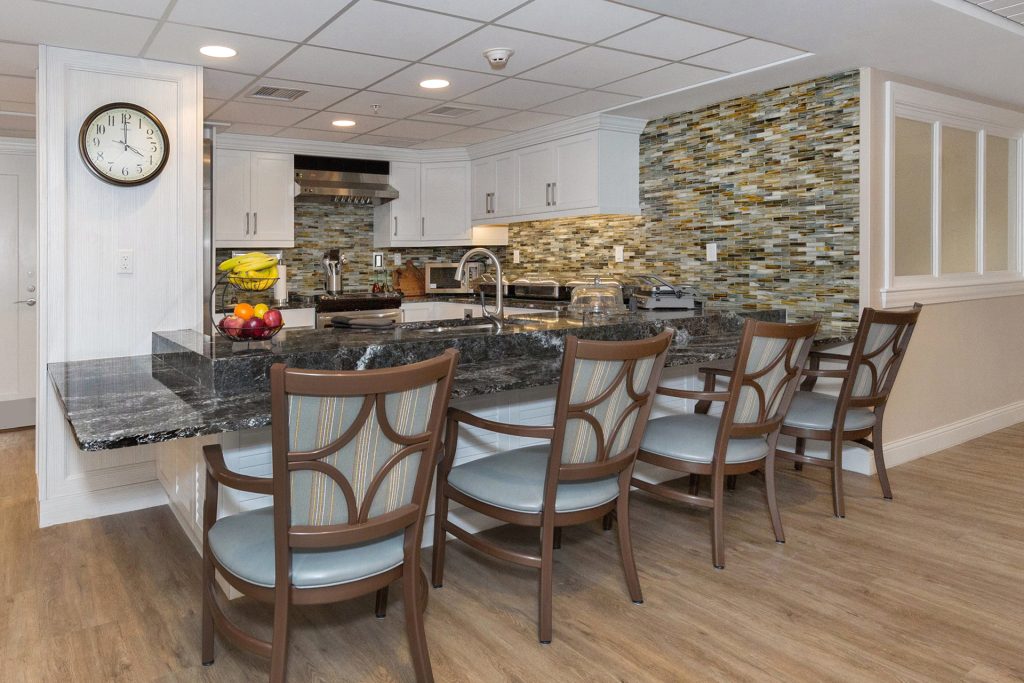
The Caspersen Lofts at Village On The Isle in Venice, Florida, is the rebirth of an existing structure into households. The five-story building includes a 16-suite household for residents living with dementia on one floor and 15 assisted living suites on each of the other floors.
The design features enlarged resident rooms and expanded, daylight-filled social spaces. The elevator lobby has been reimagined as a vestibule with a front door leading into the common spaces, reminiscent of a private residence. Village On The Isle collaborated with The Green House 2.0 Project Initiative for staff training to continue the comprehensive cultural transformation that was initiated through the physical space changes.
Design is a huge factor in the quality of experience in our memory care households,” shared Doug Feller, CEO at Village On The Isle. “But investing in staff education so that our care approach also supports a “home-like” experience for our residents has been crucial to the success of our program.”
The Small House Model
Williamsburg Landing, a memory-support and adult-day center in Williamsburg, Virginia, applies the small house concept. Their freestanding residential scale building functions as a micro-community. The program includes two 12-resident small houses, each with a living room and dining area that flank a central and open serving kitchen.
Residents move freely between the two small houses, fostering independence as well as opportunities for social interaction and friendship. Day program participants and residents take part in shared activities, furthering opportunities to engage in experiences beyond the borders of their immediate neighborhood.
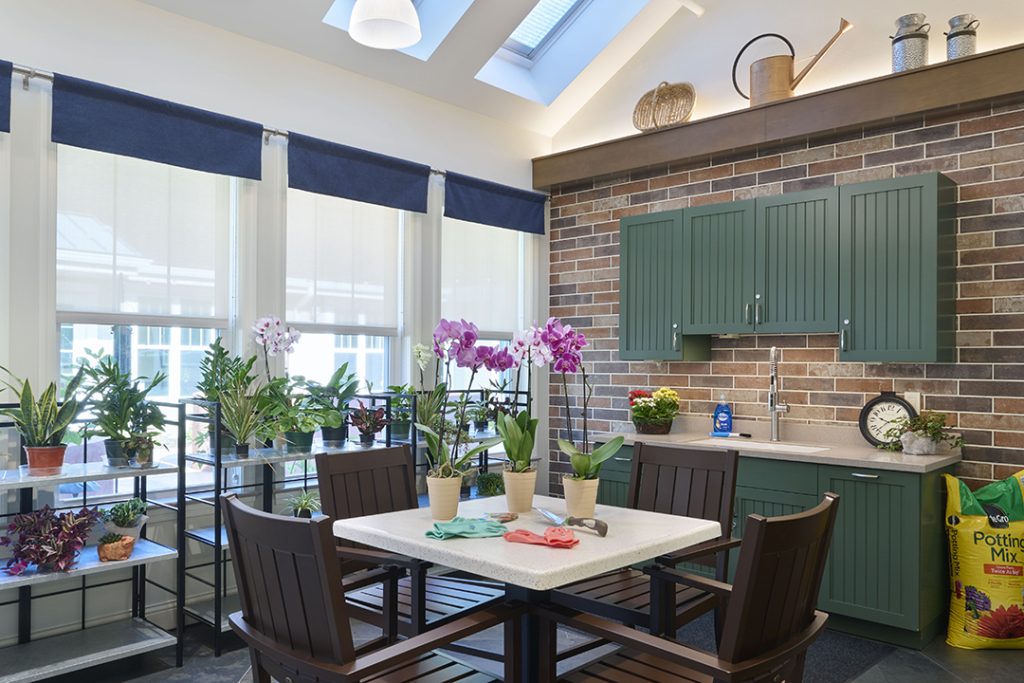
The McLean Center at Meadowood in Worcester, Pennsylvania reflects global research indicating that people living with dementia who are exposed to gardens and natural light have improved moods and slower progression of symptoms.
Paired small house residences position residents’ rooms around two internal courtyards. These individually themed, barrier-free outdoor rooms extend living spaces and create multi-directional daylight exposure within interior spaces for natural orientation to time and seasons.
Designers use techniques like: |
|
| Hierarchy of Scale – In our homes, our living room is usually larger and may have a higher ceiling than the family room or sunroom. Likewise, the type of furniture is different. | |
| Public versus Private – There should be clear delineation between private resident rooms and common activity areas. Finishes used in common areas should look and feel different than private resident spaces. | |
| Wayfinding – Provide strategically placed signs, artwork, and objects that are easily recognizable along commonly traveled paths. | |
| Each of these must be reinforced with the use of material, color, lighting, and accessories. In this way, we create paths of travel and spaces that are easily recognizable and will therefore promote resident autonomy. These techniques must be employed holistically to create an environment that synthesizes resident, family, and staff needs. |
Integrated/Non-Segregated Living
While some providers and communities care for people living with dementia in separate and secure environments, others have intentionally moved away from these specialized settings.
To be successful, this integrated living concept requires a community-wide wayfinding masterplan. In the same way that dense urban environments rely on architectural monuments, like church spires or tower elements to serve as beacons of orientation for its citizens, so too must dementia-integrated communities create unique elements throughout the environment to help with resident navigation.
Planning teams must embed cues to support wayfinding for people living with dementia. A wayfinding master plan addresses this need on a comprehensive scale. It helps with navigating a community from building to building, or understanding how to get back to the fitness center after using the restroom. While some elements may be large in scale, others might be a simple sculptural element at the crossroad of two corridors. Ultimately, integrated communities must strive for spatial literacy throughout their community to provide authentic autonomy and connectedness for residents living with dementia.
Integrated communities must also engage in rigorous staff training, technology use, and, most importantly, a community-wide commitment to understand and support residents living with dementia. Rose Villa in Portland, Oregon, fully integrates residents with dementia into the broader (life plan) community, allowing seniors to “live their best, fullest lives.”
As former CEO Vassar Byrd put it, “Integration keeps everyone’s world larger and richer and emphasizes and builds on everything the resident can still do rather than focusing on loss.”
Rose Villa’s approach demonstrates that architectural design, community culture, and staff support geared toward residents living with dementia can in fact appeal to—and ultimately benefit—all residents by removing fear and the resulting isolation.
Dementia-Dedicated Community
Input and insights from community leadership, staff, resident families, and residents themselves are invaluable to creating community-aligned environments. To define programming and design strategies that reflect the needs and desires of people living with dementia—the true experts in the process—Connecticut-based LiveWell provided focus groups for residents and their families.
We must move beyond presuming that we know what is best, and recognize people living with dementia as full citizens and partners in decision-making,” says Michael Smith, CEO of LiveWell.
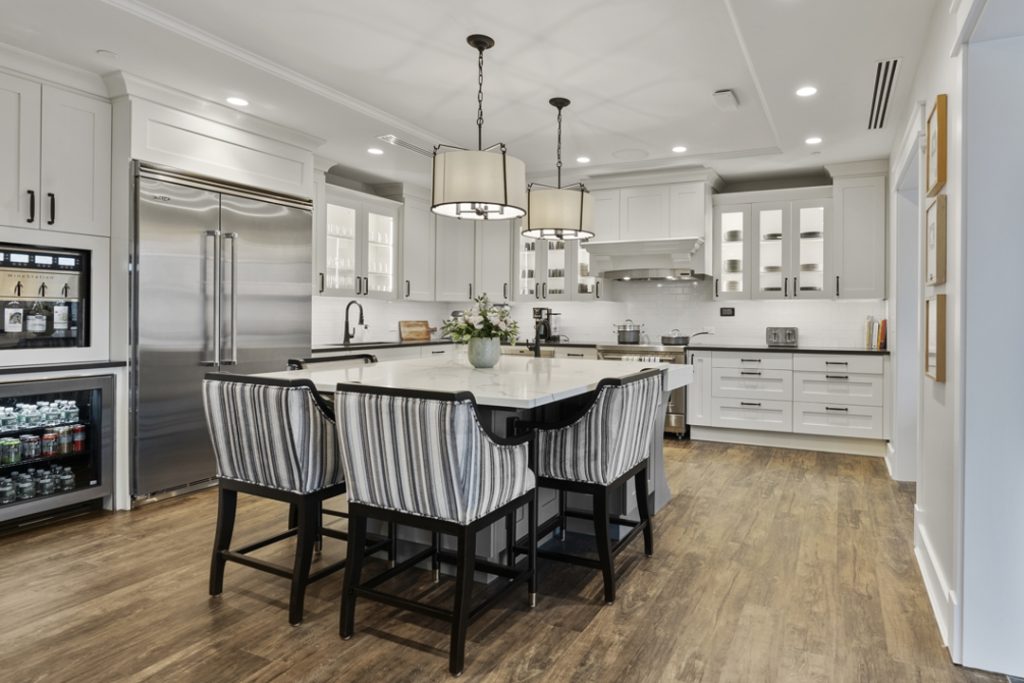
The River Homes provide a unique living arrangement for people with dementia who need limited support. Constructed to Assisted Living standards, these well-appointed residences function like New England cottages.
This new model is designed to bridge the gap for individuals who benefit from more support than typically provided in independent living, but do not need to live in a care-based setting. Each residence provides a co-living setting with the comforts and scale of a traditional home. Meal service and social planning are simply part of daily living to help residents remain engaged and living well based on their individual interests and preferences.
By listening to what people living with dementia told us was important to them, the resulting spaces engage the senses with sounds of water and music, smells of cooking, and the comfort of fresh laundry,” shares Julius. “The combined need for care with the broader pursuit of well-being encouraged program elements integrating nature, music, and the arts with design elements for privacy and independence.”
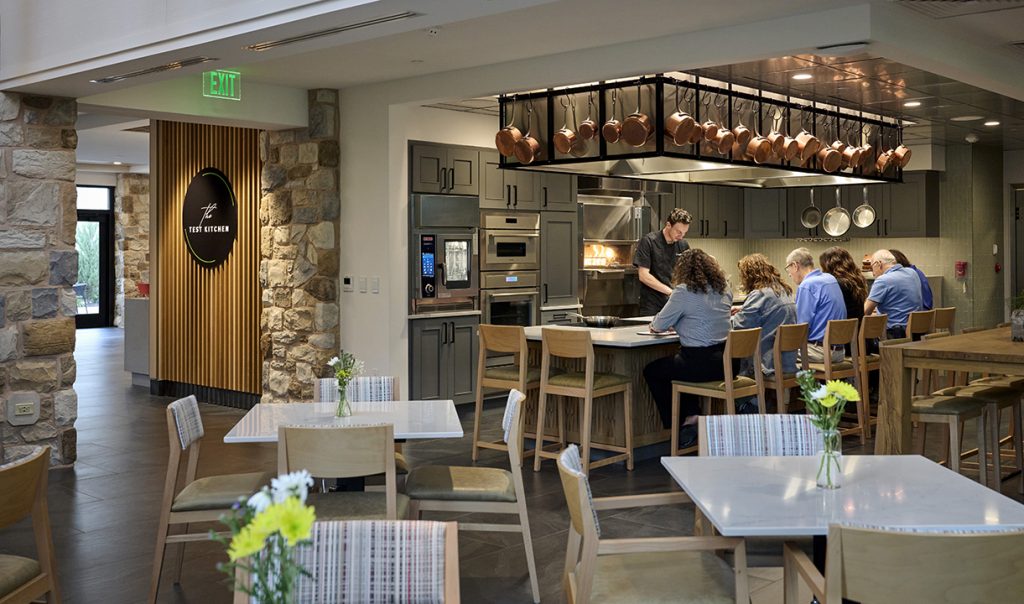
The Center for Resilient Living (CRL) enhances LiveWell’s adult day programming by providing purpose-built cultural, social, learning and wellness spaces to explore interests and pursue passions. This unique community resource provides a platform for LiveWell’s workshops, and other research, thought leadership, and education initiatives.
The 13,865 SF center’s diverse, purpose-specific activity and educational spaces include a cafe, demonstration, kitchen, greenhouse, classrooms, visual arts room, exercise studios, wellness treatment rooms, theater, media room/learning lab and offices. The Center not only serves LiveWell residents, but also accommodate education and support for the broader community as well.
Dementia-Friendly Communities
An increasing number of municipalities across the United States are taking steps to foster communities where people living with dementia are respected, understood, and supported. This approach acknowledges that the vast majority of people do not have access to a care setting and reaches far beyond the walls of a senior living campus. However, Life Plan Communities can still play a key role, serving as a community resource for education and support, as well as an elevated care option.
Our cities, towns, and neighborhoods need to take seriously the tenets of universal design, not just to allow people living with dementia to continue to thrive in the places where they already live; but because good design for people living with dementia turns out to be good design for everyone else too,” states Max Winters, Senior Designer at RLPS and Advisory Committee Member for Dementia Friendly Pennsylvania.
Program Paradigms
Consistent with LiveWell’s programmatic approach, current senior living trends show that holistic wellness is replacing care as the guiding concept for community operations. Health care professionals have long asserted that physical activity, diet, and sleep are key elements to health and wellbeing.
Reports indicate an association between these lifestyle factors and the risk of dementia or cognitive decline. These factors, along with specialized programs or creative activities inform diverse strategies and innovative programming to support the needs of people living with dementia.
Montessori Method
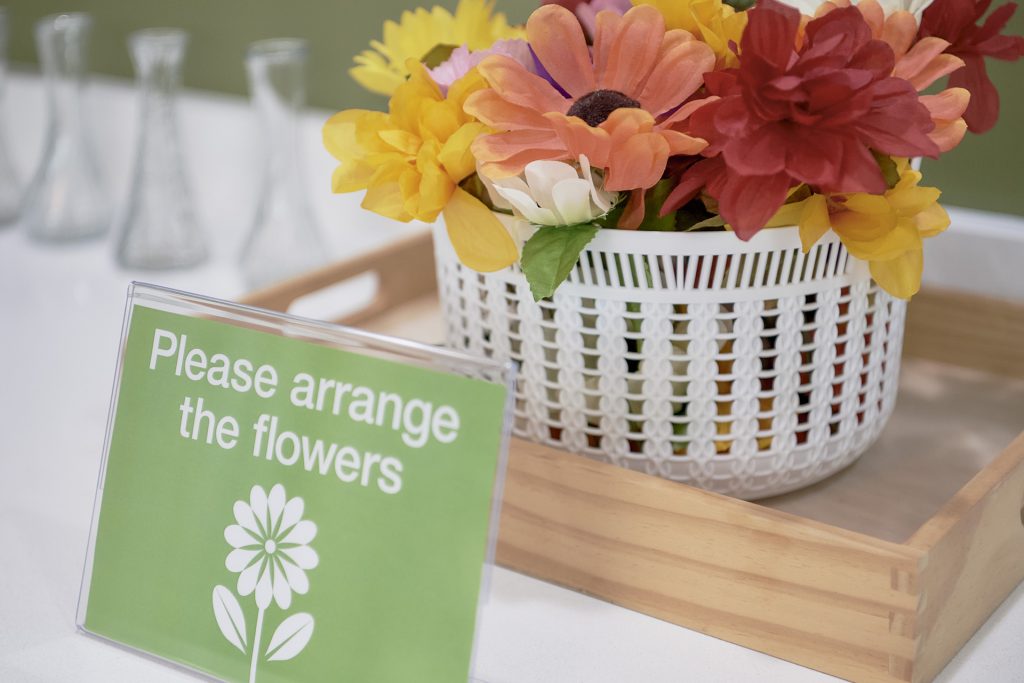
Activities performed through the Montessori Method, initially used to engage children, have been found to reduce anxiety for people with dementia by emphasizing independence, freedom within limits, and respect for a resident’s natural physical, psychological, and social development.
The Montessori Method is about providing resident-led ways to connect with long-term memories through a variety of carefully chosen objects and accessories. For example, fresh flowers and an empty vase can help a resident momentarily step out of a sense of isolation and into a beautiful spring day, because the experience of actively placing the flowers in the vase is enough to call forth the memory of cutting fresh flowers in the garden.
Older adults and people living with dementia have the same needs as everyone else—to feel valued and respected,” states Jennifer Brush, Brush Development Company. “Rather than focusing on keeping elders ‘busy,’ the prepared [Montessori] environment provides opportunities for choice, independence, and meaningful engagement. Elders given freedom to follow their interests and meet their own needs, feel fulfilled rather than bored.”
Opening Minds Through Art

Similarly, Opening Minds Through Art (OMA), an evidence-based program for people with dementia, Alzheimer’s, and other neurocognitive disorders, allows creative expression and intergenerational social engagement through art.
Developed by the Scripps Gerontology Center at Miami University in 2007, OMA pairs participants with trained volunteers who emphasize imagination over memory and focus on strengths rather than limitations. Together, they create meaningful artwork while empowering people living with dementia to become artists, teachers, and creators of a lasting legacy.
Alternative therapies and programs like Montessori and OMA are increasingly popular and proving effective in helping people live more enriched lives.
The Eden Alternative
The benchmark of The Eden Alternative is understanding that loneliness, helplessness, and boredom account for most suffering in older people, especially those living with dementia.
Eden Alternative principles focus on enabling residents to continue living their lives with dignity, respect, and privacy while striving to give them as much independence, choice, and control as they can manage. Creating small communities with dedicated staff enables close relationships to be formed between staff and residents, and between residents themselves.
The Butterfly Model
Founded by Dr. David Sheard and launched in the United Kingdom over two decades ago by parent organization ‘Dementia Care Matters’, the Butterfly Model aims to be an antidote to the impersonal and non-stimulating hospital-like environments of many memory support facilities. It is based upon a small-house and/or household concept. Spaces within the households have vibrantly painted walls to combat vision deterioration and to help people feel their spirit is alive. Within each household, residents are ‘matched,’ meaning that they are at similar stages of dementia.
The core belief of The Butterfly Movement is that everyone living with dementia can be reached as a whole person. The model values emotional intelligence in both residents and staff, domestic household living and person-centered experiences.
Green House Project Best Life
- Power of Normal: Allowing individuals to live in the least restrictive environment possible and experience culturally typical activities.
- Focus on Retained Abilities: Providing the ability to experience real relationships with pets, nature, and people of all ages.
- Dignity of Risk: Enabling individuals to maintain the basic right to take risks.
- Advocacy: Having expanded experiences and choices, as well as the right for rehabilitation.
Design Paradigms
Our understanding of cognitive decline has progressed and informed the way we partner, plan, and support people living with dementia. Physical and programming models must be synthesized with design outcomes that support each and ultimately lead to the best possible resident quality of life.
Creating Meaningful Experiences
Common to all new models and program approaches is a focus on meaningful resident experiences—seeing and engaging with individuals based on what they can do, versus their limitations. For many communities, this represents a cultural change in how care providers view their role within the community and in the lives of residents. Resident autonomy and freedom of choice is another common thread in each model and program, as well as the recognition that isolation, lack of purpose, and the feeling of helplessness have a corrosive effect on the human spirit.
There are physical design elements that can be universally applied to all memory care models and programs. This includes:
- Creating spatial literacy through embedded wayfinding elements
- Providing abundant visual and physical access to the outdoors
- Providing a variety of enriched amenity spaces so that residents can make choices about what they do, where they go and how they get there
- Providing privacy as well as connectedness and clearly differentiating the two
- Seamlessly incorporating evolving technology, lighting and acoustical considerations.
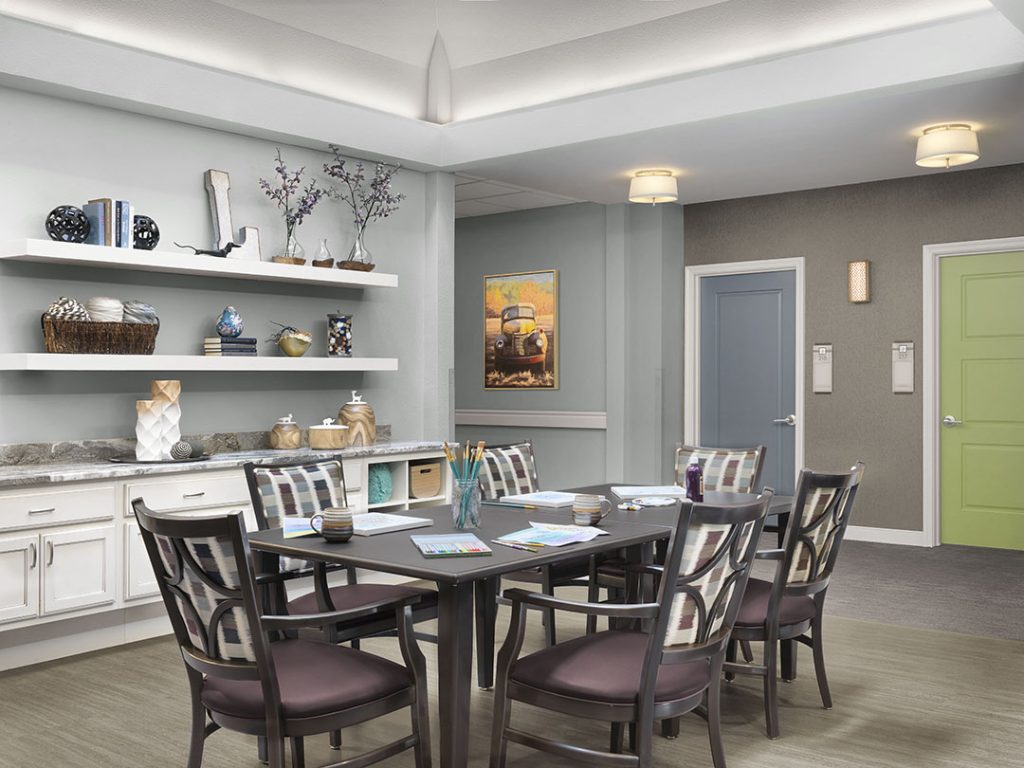
Along with common themes, each model and program also has unique aspects that require differing design approaches. For instance, small house, neighborhood, and household models each have very different staff area configurations. And depending on the programmatic approach, staff areas may be discreet, back of house spaces or, as in the Butterfly program approach, almost non-existent. In any case, design has a critical role in supporting and reinforcing the culture of care.
Integrating Technology Needs Now and in the Future
Underpinning every model, program approach and design outcome is technology. Much as design should serve as a behind-the scenes partner to a memory support community, so too should technology.
Wearable devices and other safety-oriented resources support objectives for resident independence. And changes like providing staff with hand-held devices for charting allows them to engage more fully with residents rather than disappearing into a charting room.
Sensor technology that can inform staff that a resident may need assistance has been around for years,” according to Craig Kimmel, Senior Partner RLPS. “But next generation sensor technology translates this data into information to cue staff of emerging health or elopement risks.”
New technology continues to emerge that can be directly used by residents, families, and staff to connect and engage in a variety of group and personal activities, from music and art to family photos and letters.
Tunable LED lighting mimics the color and intensity of natural daylight, which has been posited to positively affect human circadian rhythms—leading to improved sleep, alertness, and mental clarity. Even simpler lighting technology, such as motion sensors that adjust lighting levels gradually, or lighted switches that serve as a visual reminder to turn on and off, can have a significant effect.
Recognizing the Impact of Acoustics
While technology offers many options to enhance resident experience, it cannot control noise, which can also have a significant impact. The design team must anticipate noise issues by analyzing spatial volumes, finishes, and the activity planned within. Control measures must be prioritized and implemented early in the planning process. Trying to control noise issues after the fact is much more challenging and expensive, and will often negatively impact aesthetics.
Demising wall construction with a sound transmission class of at least 52 should be applied wherever possible. Where appropriate, finishes should incorporate sound-attenuating materials and minimize hard surfaces that reflect sound.
Meeting the Need
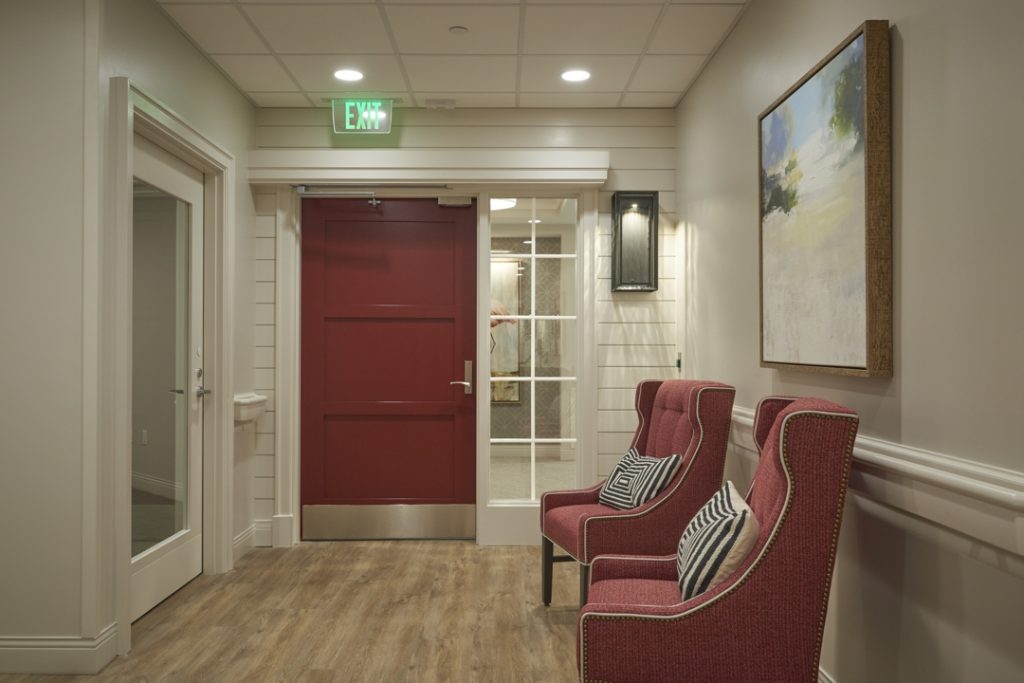
With nearly 10 million people diagnosed with dementia globally each year, the how and where these individuals receive care can have a profound impact on their quality of life. Communities, care staff, and designers will not arrive at comprehensive solutions by making decisions in separate silos. And they will not get there without listening to people living with dementia—the true experts on the subject.
All parties must work together to establish philosophical approaches, care models and programs, and seek design solutions that support each of these elements. Parallel to this effort is implementing the necessary cultural change that is foundational to any memory support success.
The outcome is not only enriched and personalized options, but also a deeper understanding of what it is like to live with dementia and how we can support each other throughout the progression of cognitive decline.
Acknowledgements
Jennifer Brush, Brush Consultants; Vassar Byrd, Rose Villa; Doug Feller, Village On The Isle; Michael Smith, LiveWell; RLPS Architects’ Contributors: Dustin Julius, Partner; Craig Kimmel, Senior Partner; Max Winters, Senior Designer